



Why & How to Build a Temporary High-Performance Scientific Team

ClinLab Solutions Group • June 19, 2024

Share this article

Have you considered using a short-term high-performance scientific team to solve your most pressing challenges? Well you are not alone. In today’s market, a temporary team built for agility and specialized expertise can be an incredibly effective solution. These teams can be pivotal in achieving rapid progress and addressing critical needs.


Here’s a guide on how to effectively build and utilize temporary high-performance scientific teams, including where to deploy them, the optimal duration for their use, and what a successful end strategy looks like.


Use Cases for Temporary Scientific Teams


  1. Accelerated Research Projects: When you have a tight deadline for a research grant or need to expedite a specific phase of a research project, a temporary team of experts can help you achieve your goals more efficiently.
  2. Product Development Sprints: For developing or refining a new product, assembling a team with diverse expertise can accelerate the innovation process, ensuring that you stay ahead of the competition.
  3. Crisis Management: In situations requiring immediate scientific analysis or intervention, such as public health emergencies or environmental disasters, a high-performance team can provide rapid, expert solutions.
  4. Specialized Testing and Validation: When a project requires specialized testing or validation that your in-house team isn’t equipped to handle, bringing in a temporary team can ensure the work is done accurately and swiftly.


Team Timetable: Determining the Duration of Use


The duration of a temporary team’s deployment depends on the project’s complexity and goals. Here are some general guidelines:


  1. Short-Term (1-3 months): Ideal for highly focused tasks like preliminary research, rapid prototyping, or urgent problem-solving. These teams are typically assembled quickly and disbanded once the immediate objective is achieved.
  2. Medium-Term (3-6 months): Suitable for comprehensive projects that require thorough investigation, development, and initial testing. This timeframe allows for more in-depth work and iterative improvements.
  3. Long-Term (6-12+ months): Used for complex projects requiring sustained effort and significant milestones. These teams can see a project from initial research through to the final stages of development and validation.


Steps to Build and Lead a Temporary High-Performance Team


  1. Define Clear Objectives: Establish specific goals, deliverables, and timelines for the project. Clear objectives will guide the selection of team members and set the stage for success.
  2. Identify Required Skills and Expertise: Determine the necessary skills and expertise based on your project objectives. This helps in selecting the right mix of professionals, ensuring all aspects of the project are covered.
  3. Recruit the Right Talent: Partner with specialized staffing agencies, like ClinLab Staffing, to quickly find and onboard qualified professionals. They can provide access to a pool of pre-screened experts ready to contribute immediately.
  4. Foster a Collaborative Culture: Encourage open communication and teamwork. Use collaboration tools to facilitate seamless interaction among team members, regardless of their physical location.
  5. Assign Clear Roles and Responsibilities: Define each team member’s role to prevent overlaps and gaps. Clear responsibilities enhance accountability and streamline project execution.
  6. Empower Your Team: Grant team members the autonomy to make decisions within their areas of expertise. This empowerment fosters innovation and enhances productivity.
  7. Monitor Progress and Provide Feedback: Regularly track the project’s progress and provide constructive feedback. Use project management tools to ensure milestones are met and adjust strategies as needed.
  8. Celebrate Achievements: Acknowledge and celebrate the team’s accomplishments to boost morale and motivation. Recognizing successes keeps the team engaged and focused.


A Successful End Strategy


A well-executed end strategy involves more than just wrapping up the project. It includes:


  1. Comprehensive Reporting: Document the project outcomes, methodologies, and key findings. This report should be detailed enough to serve as a reference for future work.
  2. Stakeholder Communication: Communicate the results and any actionable insights to all relevant stakeholders. This ensures that the project’s impact is understood and can be built upon.
  3. Knowledge Transfer: Plan for and facilitate the transfer of knowledge gained during the project to your permanent team. This can be done through detailed documentation, presentations, and training sessions.
  4. Evaluation and Feedback: Conduct a thorough evaluation of the team’s performance and the project’s outcomes. Gather feedback from team members and stakeholders to identify areas of improvement for future projects.


Temporary high-performance scientific teams are invaluable for addressing specific, short-term needs with precision and expertise. By understanding where to deploy these teams, optimizing their duration, and planning a solid end strategy, you can achieve significant progress and maintain momentum in your scientific planning.


Recent Posts

Staffing firm promo with lab scientists and office team; text reads “Specialized staffing for every stage of development”
By ClinLab Solutions Group August 14, 2025
In the life sciences, every stage from early research to clinical trials and post-approval monitoring runs on a tight schedule. Teams are expected to hit critical milestones while navigating a maze of complex regulations. The challenge is finding specialized talent quickly enough to keep studies moving. A vacant role or a poor hire can cause […] The post How Specialized Staffing Keeps Preclinical, Clinical, and Post-Approval Work on Track appeared first on ClinLab Solutions Group.

Split portrait of a doctor in glasses and a white coat, half casual and half formal suit with stethoscope
By ClinLab Solutions Group August 7, 2025
Drawn to medicine, but not the day-to-day of patient care? Holding an MD opens doors far beyond the exam room. In today’s health-driven economy, companies across industries—from biotech to health tech, pharma, legal, and consulting—are actively seeking professionals with deep medical expertise. An MD isn’t just a credential; it’s a strategic advantage. Your training equips […] The post 5 Alternative Careers for MDs appeared first on ClinLab Solutions Group.

Scientist in a white lab coat taking notes beside a microscope and blue lab glassware
By ClinLab Solutions Group July 30, 2025
How Long Do Scientists Stay in a Job in 2025, and What Does It Mean for Hiring Managers? Science professionals are staying in jobs for shorter periods than ever before. According to the latest U.S. Bureau of Labor Statistics data, median tenure for science roles is down to 3.7 years—and often lower in fast-moving sectors […] The post How Long Scientists Stay in a Job in 2025, and What It Means for Hiring Managers appeared first on ClinLab Solutions Group.

Waterfront city skyline with tall buildings, blue water, and a stone promenade under a cloudy sky
By ClinLab Solutions Group July 16, 2025
Is Your Science Career Stuck? Explore the Pros and Cons of Moving to a Biotech Hub for Lab Professionals, Researchers, and Scientists As a science staffing firm, we talk to candidates every day who ask: Should I move to grow my career in science? It’s a big decision—and the right answer depends on your goals, […] The post Should You Relocate to a Science Hub? appeared first on ClinLab Solutions Group.
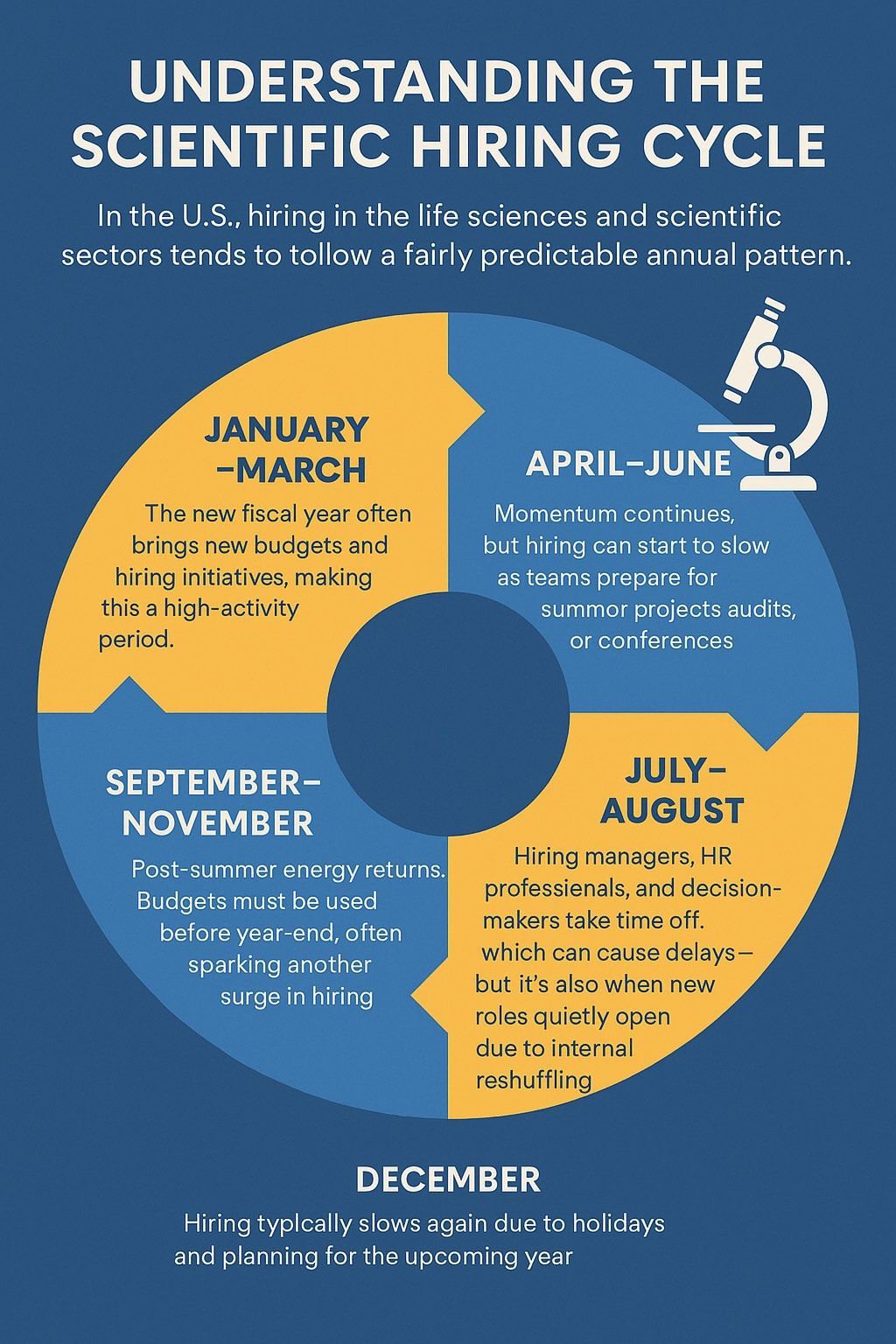
Blue infographic titled “Understanding the Scientific Hiring Cycle” with a four-part circular timeline.
By ClinLab Solutions Group July 9, 2025
Summer might feel like the slow season—vacation mode kicks in, schools are out, and the office AC becomes your best friend—but for job seekers in scientific roles, the warmer months hold strategic opportunities. While the U.S. hiring cycle does have its seasonal rhythms, summer can be a surprisingly smart time to be on the job […] The post What to Expect When Job Hunting This Summer appeared first on ClinLab Solutions Group.

Scientist in lab coat and mask holding an orange liquid flask with a test tube nearby
By ClinLab Solutions Group July 2, 2025
When life science companies need to scale their teams quickly and reliably, they can’t afford to rely on generalist staffing firms. That’s why hundreds of biotech, pharmaceutical, and diagnostics companies across the U.S. turn to ClinLab Staffing—a firm built exclusively for the scientific community. A Specialized Partner in Life Science Talent ClinLab Staffing is not […] The post Why ClinLab Staffing is a Top Choice for Life Science Staffing in the U.S. appeared first on ClinLab Solutions Group.
Gloved lab worker holding a sign: “Why specialized staffing outperforms generalists in the life sciences industry.”
By ClinLab Solutions Group June 25, 2025
At ClinLab Staffing, we’ve spent the past two decades embedded in one of the most demanding and fast-paced sectors of the global economy: the life sciences. From startup biotechs in Cambridge to Fortune 100 pharmaceutical companies nationwide, our clients all face the same challenge—finding and retaining highly specialized talent that can deliver under pressure. Increasingly, […] The post Specialized Staffing Outperforms Generalists in the Life Sciences Industry appeared first on ClinLab Solutions Group.

Scientist in a lab holding two test tubes, looking concerned, with blue and orange liquids on the table
By ClinLab Solutions Group June 20, 2025
The Hidden Costs of a Bad Science Hire—And How ClinLab Helps You Avoid Them In scientific research, pharmaceuticals, and biotech, making the right hire isn’t just important—it’s critical. The wrong hire doesn’t just affect productivity; it can jeopardize project timelines, compromise data integrity, and cost far more than just salary. At ClinLab Staffing, we specialize […] The post The Hidden Costs of a Bad Science Hire appeared first on ClinLab Solutions Group.

Medical team gathered around a laptop in a clinical setting, discussing a document with focused expressions
By ClinLab Solutions Group June 12, 2025
In clinical research, trial timelines are everything. A single staffing gap—whether it’s a missing CRA or a delayed project manager—can derail months of planning, costing sponsors money, slowing regulatory progress, and pushing critical therapies farther from the patients who need them. If you’re running or scaling a Clinical Research Organization (CRO), building a team that’s […] The post Clinical Trial Staffing: How to Build a Resilient CRO Team appeared first on ClinLab Solutions Group.

Silhouetted people in a modern lobby at sunset, with bright reflections on the polished floor.
By ClinLab Solutions Group June 4, 2025
June 2025 The hiring landscape in life sciences is evolving, and both employers and job seekers need to adapt. With a growing reliance on virtual interviews, skills-based assessments, and AI-driven screening, the hiring process is becoming more efficient—but face-to-face connections still play a vital role. Companies are balancing speed and precision when selecting candidates, while […] The post Job Interviews Are Evolving – What to Expect appeared first on ClinLab Solutions Group.
Show More