


Job Interviews Are Evolving – What to Expect

ClinLab Solutions Group • June 4, 2025

Share this article

The hiring landscape in life sciences is evolving, and both employers and job seekers need to adapt. With a growing reliance on virtual interviews, skills-based assessments, and AI-driven screening, the hiring process is becoming more efficient—but face-to-face connections still play a vital role.


Companies are balancing speed and precision when selecting candidates, while job seekers must be prepared for a mix of remote and in-person interviews. Understanding these shifts can help businesses find the right talent and enable professionals to approach their job search with confidence.


How Many Job Interview Rounds Should You Expect?

The structure of interviews varies by company, but the general trend in 2025 suggests a streamlined, competency-based approach:


  • Entry-level roles (lab assistants, research technicians): 1–2 rounds
  • Mid-level positions (quality control analysts, regulatory specialists): 2–3 rounds
  • Senior and leadership roles (principal scientists, directors): 3–5 rounds

Instead of prolonged interview processes, hiring managers are often focusing on assessing candidates’ technical skills, problem-solving ability, and cultural fit in fewer, more intensive conversations.


Remote vs. In-Person Job Interviews: What’s Changing?

Virtual hiring remains popular, but companies in life sciences understand the value of in-person interaction—especially for roles involving lab work or regulatory responsibilities. Here’s how the hiring process is shaping up:


  • Early-stage interviews (screening calls, behavioral assessments): Mostly virtual via platforms like Zoom or Microsoft Teams.
  • Technical assessments: Remote for roles focused on data analysis or computational tasks, but onsite for lab-based evaluations.
  • Panel interviews and final rounds: Many companies now hope for in-person meetings, particularly for leadership positions.
  • Onsite visits and facility tours: Still a requirement for jobs in manufacturing, clinical research, and compliance-heavy fields.

For job seekers considering remote positions, discussing expectations early is crucial. Hybrid work models are common, with many companies requiring occasional onsite visits for collaboration or equipment access.


How AI & Automation Are Changing Hiring

Hiring in life sciences is technology-driven, with companies using AI to speed up processes and improve candidate matching. Key advancements include:


  • AI-powered resume screening: Algorithms help hiring teams identify qualified candidates quickly.
  • Video interview technology: Some companies use structured, pre-recorded responses to gauge communication skills.
  • Virtual job simulations: Candidates may be tested on real-world scenarios related to their role.
  • Soft skills assessment: Employers are placing more emphasis on adaptability, emotional intelligence, and teamwork.

Job seekers should tailor their resumes to meet AI screening criteria and practice structured interview responses to stand out.


What Companies Look for in Life Science Professionals

Beyond technical qualifications, life science employers are searching for candidates who can drive impact and innovation. Expect interview discussions to focus on:


  • Technical expertise: Methodologies, laboratory techniques, and problem-solving experience.
  • Regulatory compliance: Understanding of FDA, GMP, GLP, and ISO guidelines.
  • Research contributions: The tangible effects of your work in drug development, biotechnology, or medical advancements.


Our Takeaway

For job seekers, preparing for life science interviews in 2025 means being adaptable, tech-forward, and ready for both virtual and in-person interactions. For employers, leveraging AI tools while maintaining human connection will be key to hiring the best talent. As hiring continues to evolve, success will come from preparation, precision, and the ability to embrace new recruitment strategies.


Recent Posts

Staffing firm promo with lab scientists and office team; text reads “Specialized staffing for every stage of development”
By ClinLab Solutions Group August 14, 2025
In the life sciences, every stage from early research to clinical trials and post-approval monitoring runs on a tight schedule. Teams are expected to hit critical milestones while navigating a maze of complex regulations. The challenge is finding specialized talent quickly enough to keep studies moving. A vacant role or a poor hire can cause […] The post How Specialized Staffing Keeps Preclinical, Clinical, and Post-Approval Work on Track appeared first on ClinLab Solutions Group.

Split portrait of a doctor in glasses and a white coat, half casual and half formal suit with stethoscope
By ClinLab Solutions Group August 7, 2025
Drawn to medicine, but not the day-to-day of patient care? Holding an MD opens doors far beyond the exam room. In today’s health-driven economy, companies across industries—from biotech to health tech, pharma, legal, and consulting—are actively seeking professionals with deep medical expertise. An MD isn’t just a credential; it’s a strategic advantage. Your training equips […] The post 5 Alternative Careers for MDs appeared first on ClinLab Solutions Group.

Scientist in a white lab coat taking notes beside a microscope and blue lab glassware
By ClinLab Solutions Group July 30, 2025
How Long Do Scientists Stay in a Job in 2025, and What Does It Mean for Hiring Managers? Science professionals are staying in jobs for shorter periods than ever before. According to the latest U.S. Bureau of Labor Statistics data, median tenure for science roles is down to 3.7 years—and often lower in fast-moving sectors […] The post How Long Scientists Stay in a Job in 2025, and What It Means for Hiring Managers appeared first on ClinLab Solutions Group.

Waterfront city skyline with tall buildings, blue water, and a stone promenade under a cloudy sky
By ClinLab Solutions Group July 16, 2025
Is Your Science Career Stuck? Explore the Pros and Cons of Moving to a Biotech Hub for Lab Professionals, Researchers, and Scientists As a science staffing firm, we talk to candidates every day who ask: Should I move to grow my career in science? It’s a big decision—and the right answer depends on your goals, […] The post Should You Relocate to a Science Hub? appeared first on ClinLab Solutions Group.
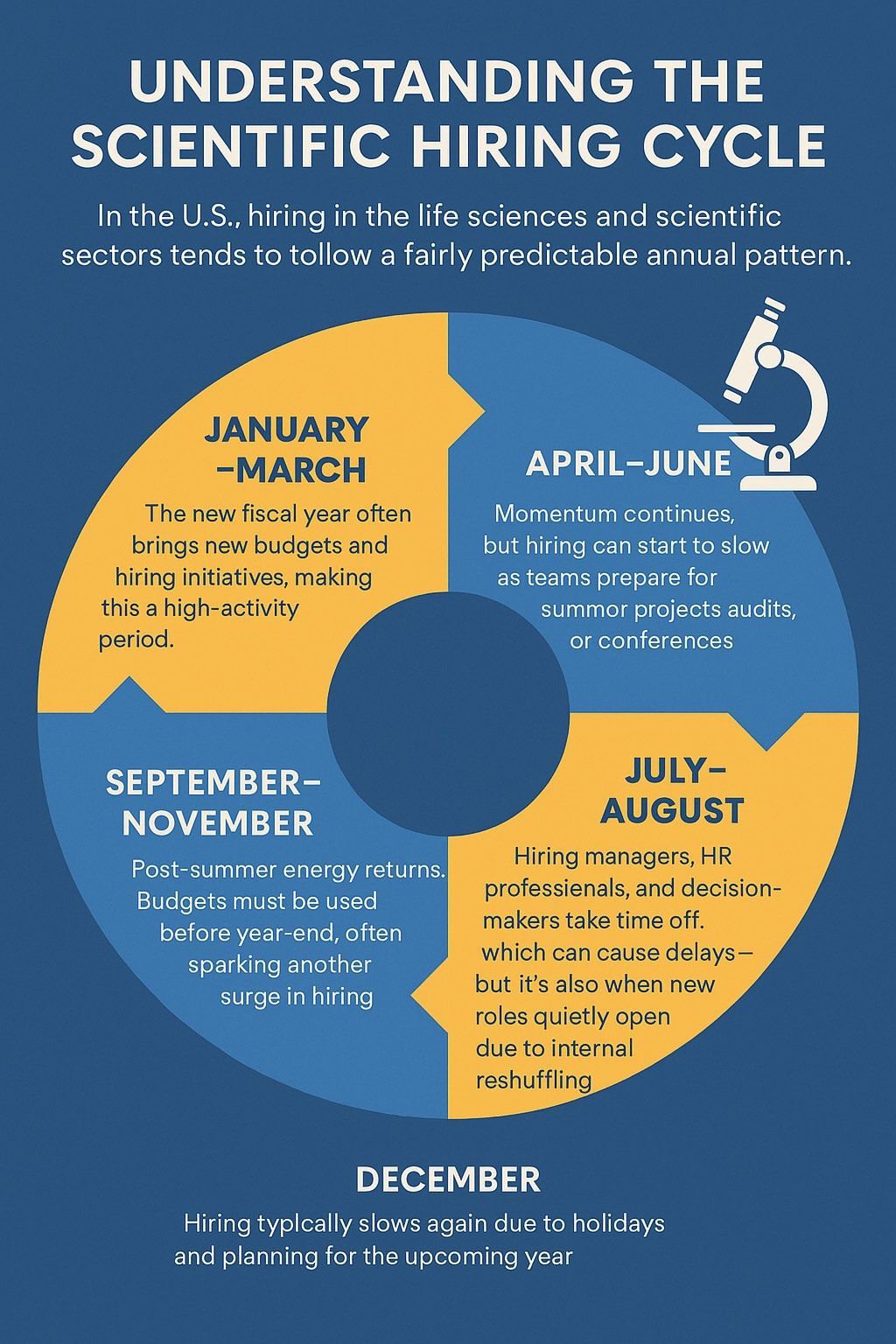
Blue infographic titled “Understanding the Scientific Hiring Cycle” with a four-part circular timeline.
By ClinLab Solutions Group July 9, 2025
Summer might feel like the slow season—vacation mode kicks in, schools are out, and the office AC becomes your best friend—but for job seekers in scientific roles, the warmer months hold strategic opportunities. While the U.S. hiring cycle does have its seasonal rhythms, summer can be a surprisingly smart time to be on the job […] The post What to Expect When Job Hunting This Summer appeared first on ClinLab Solutions Group.

Scientist in lab coat and mask holding an orange liquid flask with a test tube nearby
By ClinLab Solutions Group July 2, 2025
When life science companies need to scale their teams quickly and reliably, they can’t afford to rely on generalist staffing firms. That’s why hundreds of biotech, pharmaceutical, and diagnostics companies across the U.S. turn to ClinLab Staffing—a firm built exclusively for the scientific community. A Specialized Partner in Life Science Talent ClinLab Staffing is not […] The post Why ClinLab Staffing is a Top Choice for Life Science Staffing in the U.S. appeared first on ClinLab Solutions Group.
Gloved lab worker holding a sign: “Why specialized staffing outperforms generalists in the life sciences industry.”
By ClinLab Solutions Group June 25, 2025
At ClinLab Staffing, we’ve spent the past two decades embedded in one of the most demanding and fast-paced sectors of the global economy: the life sciences. From startup biotechs in Cambridge to Fortune 100 pharmaceutical companies nationwide, our clients all face the same challenge—finding and retaining highly specialized talent that can deliver under pressure. Increasingly, […] The post Specialized Staffing Outperforms Generalists in the Life Sciences Industry appeared first on ClinLab Solutions Group.

Scientist in a lab holding two test tubes, looking concerned, with blue and orange liquids on the table
By ClinLab Solutions Group June 20, 2025
The Hidden Costs of a Bad Science Hire—And How ClinLab Helps You Avoid Them In scientific research, pharmaceuticals, and biotech, making the right hire isn’t just important—it’s critical. The wrong hire doesn’t just affect productivity; it can jeopardize project timelines, compromise data integrity, and cost far more than just salary. At ClinLab Staffing, we specialize […] The post The Hidden Costs of a Bad Science Hire appeared first on ClinLab Solutions Group.

Medical team gathered around a laptop in a clinical setting, discussing a document with focused expressions
By ClinLab Solutions Group June 12, 2025
In clinical research, trial timelines are everything. A single staffing gap—whether it’s a missing CRA or a delayed project manager—can derail months of planning, costing sponsors money, slowing regulatory progress, and pushing critical therapies farther from the patients who need them. If you’re running or scaling a Clinical Research Organization (CRO), building a team that’s […] The post Clinical Trial Staffing: How to Build a Resilient CRO Team appeared first on ClinLab Solutions Group.

GMP audits poster over industrial pipework with worker in hard hat checking a device
By ClinLab Solutions Group May 29, 2025
How to Prepare & Staff for GMP Audits What Life Science Companies Need to Know If you’re part of a life science company—whether in pharmaceuticals, biotech, or medical device manufacturing—GMP audits aren’t just another checkbox. They’re a regulatory necessity that can determine your ability to operate, grow, or even survive in a competitive market. Yet many […] The post How to Prepare & Staff for GMP Audits appeared first on ClinLab Solutions Group.
Show More