


What is a Biomedical Engineer?

ClinLab Solutions Group • January 22, 2025

Share this article

Biomedical engineering is a rapidly evolving field that bridges the gap between medicine and technology. At its core, biomedical engineering applies principles of engineering and biology to develop innovative solutions for healthcare. Biomedical engineers play a vital role in improving patient outcomes, advancing medical research, and enhancing the quality of life for people worldwide.


The field is incredibly diverse, offering a wide range of career opportunities. Below, we explore some of the most common types of biomedical engineering jobs and their unique contributions to healthcare:


1. Bioinstrumentation Engineer


Focus: Design and development of medical devices and instruments. Examples: Imaging machines (MRI, X-ray), diagnostic tools, and wearable health monitors.


Bioinstrumentation engineers create the tools that healthcare providers use to diagnose and treat patients. Their work ensures precision and reliability in life-saving equipment.


2. Biomaterials Engineer


Focus: Development of materials compatible with the human body. Examples: Artificial organs, dental implants, and surgical sutures.


Biomaterials engineers work on creating substances that interact safely with biological systems. These materials are essential for surgeries, implants, and regenerative medicine.


3. Biomechanics Engineer


Focus: Study of mechanics as applied to the human body. Examples: Designing prosthetics, orthotics, and ergonomic devices.


Biomechanics engineers analyze how forces interact with the human body to develop devices that improve mobility, comfort, and function.


4. Clinical Engineer


Focus: Application of technology in healthcare settings. Examples: Managing medical equipment in hospitals and ensuring compliance with regulations.


Clinical engineers act as a bridge between engineering and patient care, ensuring that medical devices are safe, effective, and properly maintained.


5. Tissue and Cellular Engineer


Focus: Development of biological substitutes to restore or replace damaged tissues or organs. Examples: Regenerative medicine, stem cell therapy, and bio-artificial organs.


This field is at the forefront of cutting-edge research, offering hope for treatments that can heal previously irreparable damage.


6. Systems Physiology Engineer


Focus: Understanding biological systems and developing models to improve healthcare solutions. Examples: Modeling cardiovascular systems or creating simulations for drug testing.


These engineers analyze complex systems within the body to predict outcomes and optimize treatments.


7. Pharmaceutical Engineer


Focus: Development of drug delivery systems and biotechnological products. Examples: Insulin pumps, controlled-release medications, and implantable drug delivery systems.


Pharmaceutical engineers design innovative ways to deliver medications safely and effectively, improving therapeutic outcomes.


8. Bioinformatics Specialist


Focus: Application of data analysis and computational models to biological problems. Examples: Analyzing genetic data, disease modeling, and developing software for healthcare research.


Bioinformatics specialists harness the power of data to drive discoveries in genetics, personalized medicine, and disease prevention.


9. Neural Engineer


Focus: Interfacing with and understanding the nervous system. Examples: Brain-computer interfaces, neural implants, and devices for neurorehabilitation.


Neural engineers develop technologies that connect directly to the nervous system, offering groundbreaking treatments for neurological disorders.


10. Research and Development Engineer


Focus: Innovating new technologies and improving existing healthcare solutions. Examples: Experimental medical devices, wearable technologies, and diagnostic tools.


R&D engineers are the creative force behind new breakthroughs, pushing the boundaries of what is possible in healthcare technology.


Partner with ClinLab Staffing for Biomedical Engineering Talent


As the life sciences industry continues to grow, the demand for highly specialized biomedical engineers is on the rise. ClinLab Staffing offers flexible and reliable staffing solutions to meet your recruiting needs. Whether you require full-time professionals or short-term project support, ClinLab connects you with top talent to fill critical roles in biomedical engineering and beyond.


Reach out today to learn how we can help your organization thrive in this dynamic industry.


Recent Posts

Staffing firm promo with lab scientists and office team; text reads “Specialized staffing for every stage of development”
By ClinLab Solutions Group August 14, 2025
In the life sciences, every stage from early research to clinical trials and post-approval monitoring runs on a tight schedule. Teams are expected to hit critical milestones while navigating a maze of complex regulations. The challenge is finding specialized talent quickly enough to keep studies moving. A vacant role or a poor hire can cause […] The post How Specialized Staffing Keeps Preclinical, Clinical, and Post-Approval Work on Track appeared first on ClinLab Solutions Group.

Split portrait of a doctor in glasses and a white coat, half casual and half formal suit with stethoscope
By ClinLab Solutions Group August 7, 2025
Drawn to medicine, but not the day-to-day of patient care? Holding an MD opens doors far beyond the exam room. In today’s health-driven economy, companies across industries—from biotech to health tech, pharma, legal, and consulting—are actively seeking professionals with deep medical expertise. An MD isn’t just a credential; it’s a strategic advantage. Your training equips […] The post 5 Alternative Careers for MDs appeared first on ClinLab Solutions Group.

Scientist in a white lab coat taking notes beside a microscope and blue lab glassware
By ClinLab Solutions Group July 30, 2025
How Long Do Scientists Stay in a Job in 2025, and What Does It Mean for Hiring Managers? Science professionals are staying in jobs for shorter periods than ever before. According to the latest U.S. Bureau of Labor Statistics data, median tenure for science roles is down to 3.7 years—and often lower in fast-moving sectors […] The post How Long Scientists Stay in a Job in 2025, and What It Means for Hiring Managers appeared first on ClinLab Solutions Group.

Waterfront city skyline with tall buildings, blue water, and a stone promenade under a cloudy sky
By ClinLab Solutions Group July 16, 2025
Is Your Science Career Stuck? Explore the Pros and Cons of Moving to a Biotech Hub for Lab Professionals, Researchers, and Scientists As a science staffing firm, we talk to candidates every day who ask: Should I move to grow my career in science? It’s a big decision—and the right answer depends on your goals, […] The post Should You Relocate to a Science Hub? appeared first on ClinLab Solutions Group.
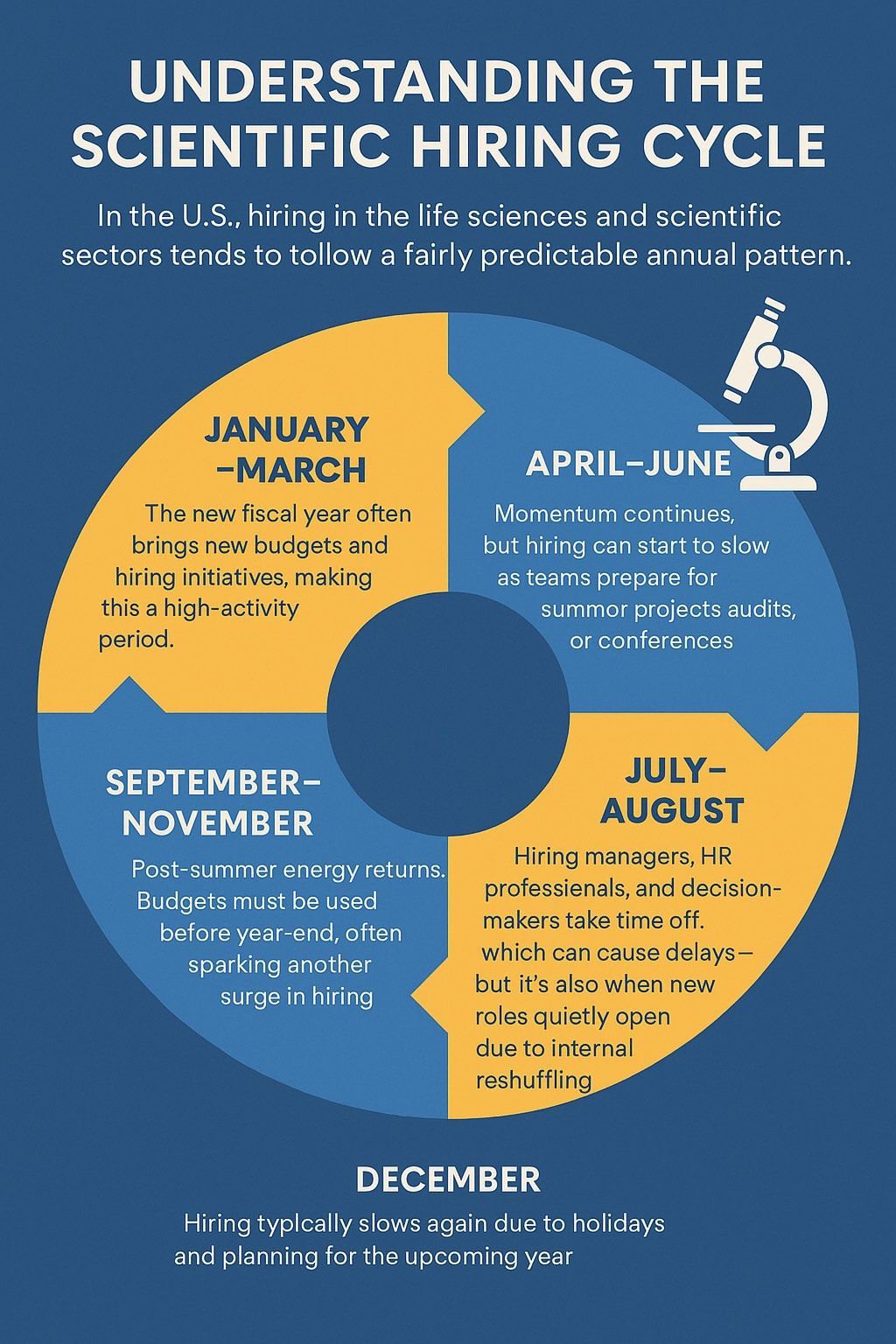
Blue infographic titled “Understanding the Scientific Hiring Cycle” with a four-part circular timeline.
By ClinLab Solutions Group July 9, 2025
Summer might feel like the slow season—vacation mode kicks in, schools are out, and the office AC becomes your best friend—but for job seekers in scientific roles, the warmer months hold strategic opportunities. While the U.S. hiring cycle does have its seasonal rhythms, summer can be a surprisingly smart time to be on the job […] The post What to Expect When Job Hunting This Summer appeared first on ClinLab Solutions Group.

Scientist in lab coat and mask holding an orange liquid flask with a test tube nearby
By ClinLab Solutions Group July 2, 2025
When life science companies need to scale their teams quickly and reliably, they can’t afford to rely on generalist staffing firms. That’s why hundreds of biotech, pharmaceutical, and diagnostics companies across the U.S. turn to ClinLab Staffing—a firm built exclusively for the scientific community. A Specialized Partner in Life Science Talent ClinLab Staffing is not […] The post Why ClinLab Staffing is a Top Choice for Life Science Staffing in the U.S. appeared first on ClinLab Solutions Group.
Gloved lab worker holding a sign: “Why specialized staffing outperforms generalists in the life sciences industry.”
By ClinLab Solutions Group June 25, 2025
At ClinLab Staffing, we’ve spent the past two decades embedded in one of the most demanding and fast-paced sectors of the global economy: the life sciences. From startup biotechs in Cambridge to Fortune 100 pharmaceutical companies nationwide, our clients all face the same challenge—finding and retaining highly specialized talent that can deliver under pressure. Increasingly, […] The post Specialized Staffing Outperforms Generalists in the Life Sciences Industry appeared first on ClinLab Solutions Group.

Scientist in a lab holding two test tubes, looking concerned, with blue and orange liquids on the table
By ClinLab Solutions Group June 20, 2025
The Hidden Costs of a Bad Science Hire—And How ClinLab Helps You Avoid Them In scientific research, pharmaceuticals, and biotech, making the right hire isn’t just important—it’s critical. The wrong hire doesn’t just affect productivity; it can jeopardize project timelines, compromise data integrity, and cost far more than just salary. At ClinLab Staffing, we specialize […] The post The Hidden Costs of a Bad Science Hire appeared first on ClinLab Solutions Group.

Medical team gathered around a laptop in a clinical setting, discussing a document with focused expressions
By ClinLab Solutions Group June 12, 2025
In clinical research, trial timelines are everything. A single staffing gap—whether it’s a missing CRA or a delayed project manager—can derail months of planning, costing sponsors money, slowing regulatory progress, and pushing critical therapies farther from the patients who need them. If you’re running or scaling a Clinical Research Organization (CRO), building a team that’s […] The post Clinical Trial Staffing: How to Build a Resilient CRO Team appeared first on ClinLab Solutions Group.

Silhouetted people in a modern lobby at sunset, with bright reflections on the polished floor.
By ClinLab Solutions Group June 4, 2025
June 2025 The hiring landscape in life sciences is evolving, and both employers and job seekers need to adapt. With a growing reliance on virtual interviews, skills-based assessments, and AI-driven screening, the hiring process is becoming more efficient—but face-to-face connections still play a vital role. Companies are balancing speed and precision when selecting candidates, while […] The post Job Interviews Are Evolving – What to Expect appeared first on ClinLab Solutions Group.
Show More