



Top cities for STEM jobs in New England

ClinLab Solutions Group • November 27, 2015

Share this article

A recent article from Wallet Hub ranked the best and worst metropolitan areas for STEM (Science, Technology, Engineering, and Math) professionals to work. The Houston, Woodlands, and Sugarland area in Texas took the coveted number one spot, while the Miami, Fort Lauderdale, and West Palm Beach area of Florida fell into last place.


Jobs in STEM fields usually require a great deal of education and training and not surprisingly these types of positions have greater than average salaries across the US, but not all metropolitan areas are created equal, as far as STEM opportunities that is. For instance according to Wallet Hub, Raleigh, NC has the highest STEM employment growth in the country. Whereas New York, NY has the highest annual median wage growth.


Source: WalletHub


So where does New England fall into all of this? The Boston, Cambridge, Newton area is the top rated in New England, coming in at number 35. Massachusetts has by far the most locations in New England with four (Boston-Cambridge-Newton-35, Worcester-41, Warwick-66, and Springfield-73). Rhode Island and Connecticut both have one, Providence- 66 and Bridgeport-Stamford-Norwalk-61, respectively. But what is the point of this? These figures expand beyond where the best places to work or make more money are.


While the United States has always held a strong position internationally in technological innovation, competition is fiercer than ever, and for the US to stay competitive, about a million more jobs need to be created by 2018, a figure the federal government is committed to achieving. With such a dramatic increase in jobs, it is interesting that when Wallet Hub asked experts if STEM job shortages were a myth, they got very different answers from experts in different fields. On one hand, experts in the technology and engineering fields do not believe there is a shortage of STEM jobs. While on the other hand, experts in science fields believe there is a STEM shortage.


What can account for such disparaging views? While STEM is a convenient grouping for analysis, in reality these job markets are independent of each other. For example, the sciences might be seeing slower growth than other STEM fields because it relies more heavily on federal funding, such as grants given out by the NIH, which have been steadily decreasing since 2003 due to budget cuts, sequestration, and inflation. The sciences, particularly any kind of research, tend to be higher risk than other STEM fields because of the lower probability of success and higher cost, making them less likely to draw adequate private funding. Therefore, the growth of jobs in science is more heavily affected, keeping the job market very competitive.


Lower risk fields, such as engineering and mathematics, that do not rely on such funds are not experiencing restricted growth. Thus, the STEM job shortage is not experienced. Regardless of funding changes or job growth, the market remains competitive with more people than ever earning advanced degrees, and competition is even more pronounced in the top metropolitan areas.


For those wanting to enter or rise through the ranks in STEM fields, it is important to stand out to employers by not only having an impressive resume, but by focusing on more widely applicable skills. In a recent article, Forbes had employers rank skills they deemed most important. Technical skills in the field ranked seventh out of ten. Skills such as the ability to work as part of a team, critical thinking, and organizational skills were ranked the top three. By being both specifically trained in your field and maintaining a broad skill set, you can stand out even in the most competitive job markets.


Recent Posts

Staffing firm promo with lab scientists and office team; text reads “Specialized staffing for every stage of development”
By ClinLab Solutions Group August 14, 2025
In the life sciences, every stage from early research to clinical trials and post-approval monitoring runs on a tight schedule. Teams are expected to hit critical milestones while navigating a maze of complex regulations. The challenge is finding specialized talent quickly enough to keep studies moving. A vacant role or a poor hire can cause […] The post How Specialized Staffing Keeps Preclinical, Clinical, and Post-Approval Work on Track appeared first on ClinLab Solutions Group.

Split portrait of a doctor in glasses and a white coat, half casual and half formal suit with stethoscope
By ClinLab Solutions Group August 7, 2025
Drawn to medicine, but not the day-to-day of patient care? Holding an MD opens doors far beyond the exam room. In today’s health-driven economy, companies across industries—from biotech to health tech, pharma, legal, and consulting—are actively seeking professionals with deep medical expertise. An MD isn’t just a credential; it’s a strategic advantage. Your training equips […] The post 5 Alternative Careers for MDs appeared first on ClinLab Solutions Group.

Scientist in a white lab coat taking notes beside a microscope and blue lab glassware
By ClinLab Solutions Group July 30, 2025
How Long Do Scientists Stay in a Job in 2025, and What Does It Mean for Hiring Managers? Science professionals are staying in jobs for shorter periods than ever before. According to the latest U.S. Bureau of Labor Statistics data, median tenure for science roles is down to 3.7 years—and often lower in fast-moving sectors […] The post How Long Scientists Stay in a Job in 2025, and What It Means for Hiring Managers appeared first on ClinLab Solutions Group.

Waterfront city skyline with tall buildings, blue water, and a stone promenade under a cloudy sky
By ClinLab Solutions Group July 16, 2025
Is Your Science Career Stuck? Explore the Pros and Cons of Moving to a Biotech Hub for Lab Professionals, Researchers, and Scientists As a science staffing firm, we talk to candidates every day who ask: Should I move to grow my career in science? It’s a big decision—and the right answer depends on your goals, […] The post Should You Relocate to a Science Hub? appeared first on ClinLab Solutions Group.
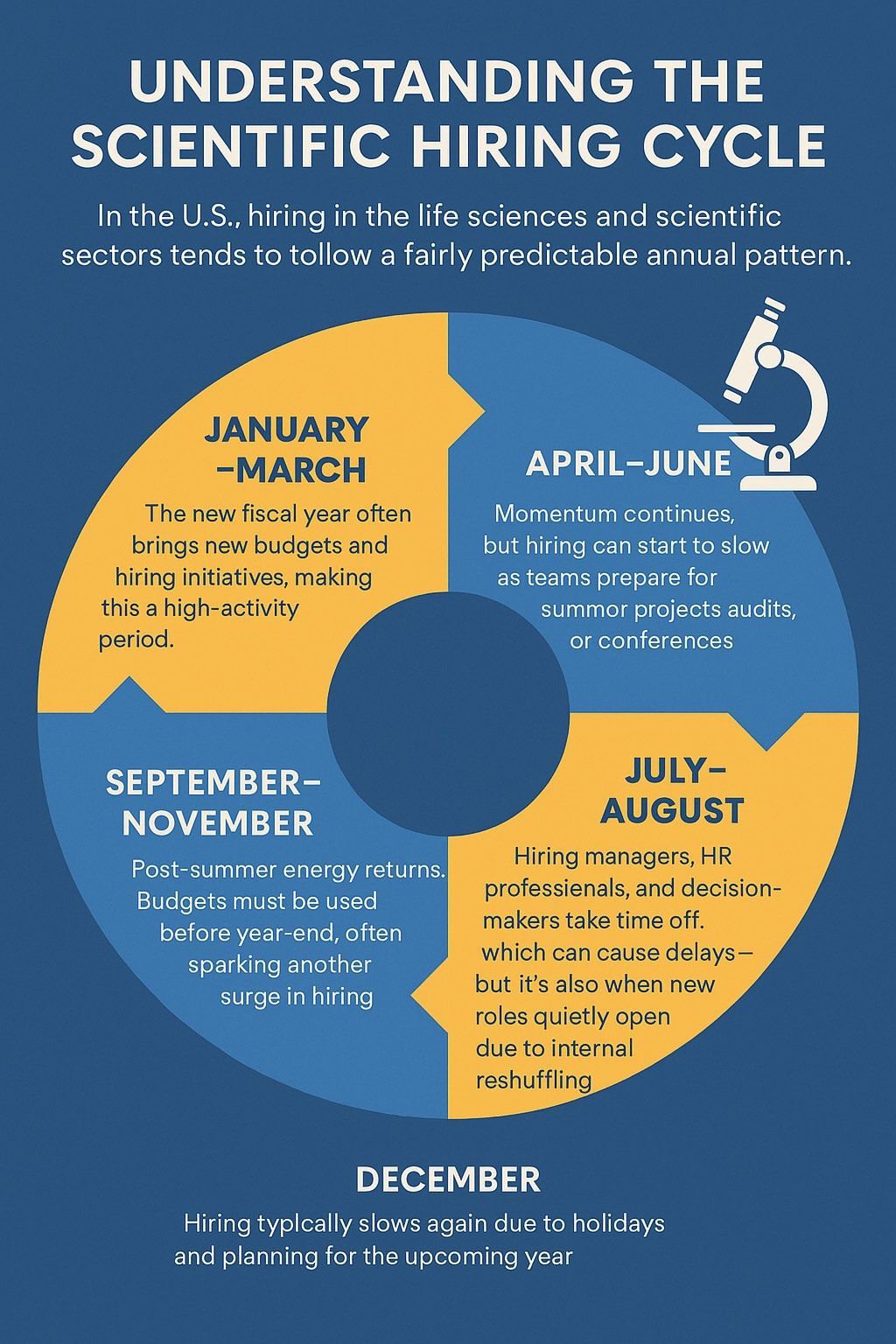
Blue infographic titled “Understanding the Scientific Hiring Cycle” with a four-part circular timeline.
By ClinLab Solutions Group July 9, 2025
Summer might feel like the slow season—vacation mode kicks in, schools are out, and the office AC becomes your best friend—but for job seekers in scientific roles, the warmer months hold strategic opportunities. While the U.S. hiring cycle does have its seasonal rhythms, summer can be a surprisingly smart time to be on the job […] The post What to Expect When Job Hunting This Summer appeared first on ClinLab Solutions Group.

Scientist in lab coat and mask holding an orange liquid flask with a test tube nearby
By ClinLab Solutions Group July 2, 2025
When life science companies need to scale their teams quickly and reliably, they can’t afford to rely on generalist staffing firms. That’s why hundreds of biotech, pharmaceutical, and diagnostics companies across the U.S. turn to ClinLab Staffing—a firm built exclusively for the scientific community. A Specialized Partner in Life Science Talent ClinLab Staffing is not […] The post Why ClinLab Staffing is a Top Choice for Life Science Staffing in the U.S. appeared first on ClinLab Solutions Group.
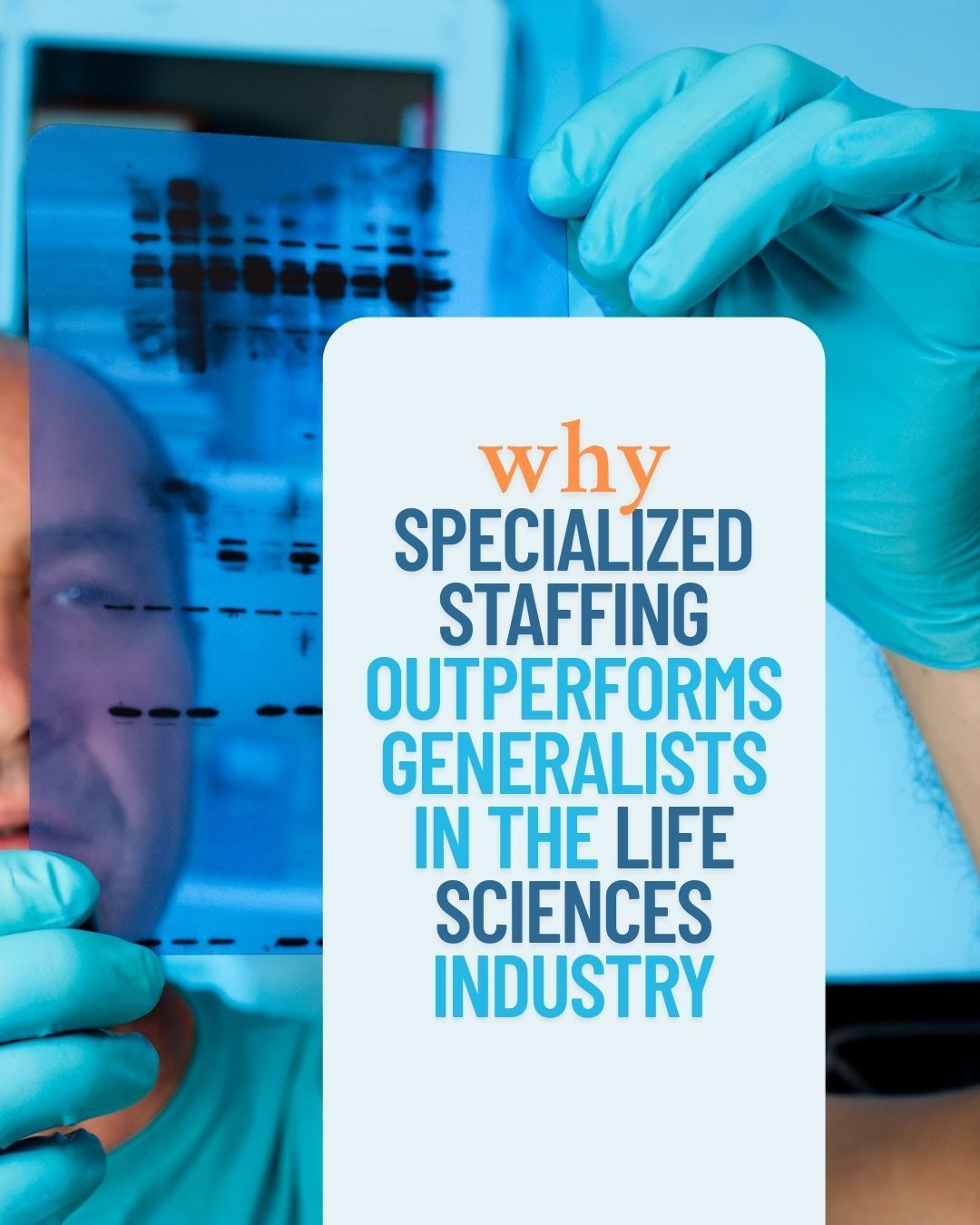
Gloved lab worker holding a sign: “Why specialized staffing outperforms generalists in the life sciences industry.”
By ClinLab Solutions Group June 25, 2025
At ClinLab Staffing, we’ve spent the past two decades embedded in one of the most demanding and fast-paced sectors of the global economy: the life sciences. From startup biotechs in Cambridge to Fortune 100 pharmaceutical companies nationwide, our clients all face the same challenge—finding and retaining highly specialized talent that can deliver under pressure. Increasingly, […] The post Specialized Staffing Outperforms Generalists in the Life Sciences Industry appeared first on ClinLab Solutions Group.

Scientist in a lab holding two test tubes, looking concerned, with blue and orange liquids on the table
By ClinLab Solutions Group June 20, 2025
The Hidden Costs of a Bad Science Hire—And How ClinLab Helps You Avoid Them In scientific research, pharmaceuticals, and biotech, making the right hire isn’t just important—it’s critical. The wrong hire doesn’t just affect productivity; it can jeopardize project timelines, compromise data integrity, and cost far more than just salary. At ClinLab Staffing, we specialize […] The post The Hidden Costs of a Bad Science Hire appeared first on ClinLab Solutions Group.

Medical team gathered around a laptop in a clinical setting, discussing a document with focused expressions
By ClinLab Solutions Group June 12, 2025
In clinical research, trial timelines are everything. A single staffing gap—whether it’s a missing CRA or a delayed project manager—can derail months of planning, costing sponsors money, slowing regulatory progress, and pushing critical therapies farther from the patients who need them. If you’re running or scaling a Clinical Research Organization (CRO), building a team that’s […] The post Clinical Trial Staffing: How to Build a Resilient CRO Team appeared first on ClinLab Solutions Group.

Silhouetted people in a modern lobby at sunset, with bright reflections on the polished floor.
By ClinLab Solutions Group June 4, 2025
June 2025 The hiring landscape in life sciences is evolving, and both employers and job seekers need to adapt. With a growing reliance on virtual interviews, skills-based assessments, and AI-driven screening, the hiring process is becoming more efficient—but face-to-face connections still play a vital role. Companies are balancing speed and precision when selecting candidates, while […] The post Job Interviews Are Evolving – What to Expect appeared first on ClinLab Solutions Group.
Show More