


Building a Super Employee Multiplier: How Strategic Staffing Amplifies Team Performance

ClinLab Solutions Group • October 23, 2024

Share this article

In science, the narrative of success often revolves around the lone genius—Newton under the apple tree or Marie Curie in her lab. But the truth is, breakthroughs, especially in today’s fast-paced, collaborative environment, are rarely the work of solitary brilliance. They emerge from teams: groups of people whose combined efforts can far exceed the sum of their parts. This is where the concept of the super employee multiplier comes into play.


What if, instead of focusing on hiring “rockstar” employees, you focused on how to structure your team to amplify the performance of everyone involved? This is the power of strategic staffing. The way you build your team can fundamentally change not only what that team achieves but how efficiently it operates. Strategic staffing can unlock the hidden potential within your team, creating an environment where the work of one employee multiplies the impact of everyone else.


The Power of Synergy: Why 1 + 1 = 3


In 1954, psychologist Solomon Asch conducted a series of experiments that changed the way we think about group dynamics. Asch was interested in conformity—how the presence of others can influence an individual’s decision-making. His research demonstrated something intriguing: when people work in groups, their actions and decisions aren’t just shaped by their own abilities but by the behavior of those around them.


In a scientific setting, this means that the capabilities of a single employee can be amplified or diminished depending on the makeup of the team. A biochemist who excels in problem-solving may be stuck in the mud without an engineer to help translate those ideas into actionable steps. Likewise, a brilliant researcher with innovative ideas may be spinning their wheels unless they’re paired with a project manager who can turn those ideas into reality.


Strategic staffing isn’t just about finding skilled individuals—it’s about finding the right individuals whose talents enhance the performance of the group.


The Matthew Effect of Talent


Sociologist Robert Merton coined the term “The Matthew Effect” in 1968 to describe a curious phenomenon in academia: the more recognition you receive, the more likely you are to receive further recognition. It’s a reinforcing loop, a snowball effect. In a similar way, staffing the right employees can create a “Matthew Effect” within your organization. As the team performs better, the rewards increase—not just in terms of scientific results but in employee engagement, satisfaction, and retention.


Take a typical lab setting. If you hire a brilliant researcher who works well in isolation, you may get good results. But if you hire someone with strong collaborative instincts, the benefits compound. This person doesn’t just perform their own tasks well—they raise the level of their colleagues. The team’s ideas sharpen, solutions come faster, and obstacles shrink. Suddenly, that one hire has made your entire team better.


The Pygmalion Effect in Action


In 1968, two psychologists, Robert Rosenthal and Lenore Jacobson, conducted a famous experiment in a California elementary school. Teachers were told that certain students had been identified as having high potential, based on a (fabricated) test. Over the course of the year, those students did indeed perform better—because the teachers treated them differently, investing more time and energy into their development.


This Pygmalion Effect—the idea that expectations shape reality—has enormous implications in the workplace. It suggests that who you hire is only part of the equation. How you staff your team, how you treat those hires, and what you expect from them can alter their performance dramatically.


Think about this in the context of strategic staffing. If you build a team expecting them to operate as independent silos, that’s what you’ll get: employees who work in isolation, producing work that may be technically sound but lacks the cohesion and synergy of a truly collaborative team. But if you create an environment that fosters collaboration and empowers employees to lead projects, suggest new ideas, and drive innovation together, the result will be a team that not only meets expectations but often exceeds them.


Why Flexibility Outperforms Rigid Expertise


In 1975, a psychologist named Paul Baltes introduced the concept of “selective optimization with compensation.” He studied aging and how people maintain performance in old age despite a decline in certain abilities. Baltes found that successful individuals learned to optimize their strengths and compensate for their weaknesses by working with others.


Strategic staffing works much the same way. Rather than hiring rigidly for one set of skills or expertise, consider how flexible, cross-disciplinary hires can compensate for the gaps in your team. In a research environment, no single employee can know everything. The person who has an encyclopedic knowledge of genomics might lack data analysis skills. The one who’s a master of lab protocols may struggle with project management.


Here’s where strategic staffing can play a critical role. When you hire with flexibility in mind, you create an agile team capable of solving problems from multiple angles. You hire not for the job description but for the gaps in your existing team’s capabilities. This gives you a team that adapts easily to new challenges—one that isn’t derailed by the unexpected but rather energized by it.


Ultimately, the concept of the super employee multiplier is about more than just staffing for productivity—it’s about creating a team dynamic where each employee’s strengths multiply the effectiveness of everyone else. It’s about hiring not for individual brilliance but for collective impact.


Think of the Wright brothers. They weren’t the most educated or well-funded inventors working on powered flight. But they had something far more important: a perfectly complementary skill set and an ability to work in tandem. Or think of John Lennon and Paul McCartney, whose combined talents transformed popular music in a way neither could have accomplished on their own.

In the scientific world, staffing strategically can create these same kinds of synergies. A well-constructed team isn’t just a group of experts—it’s a self-reinforcing system that continuously improves and innovates. It’s a multiplier that turns individual contributions into collective breakthroughs.


In science, the quest for breakthroughs can’t be done in isolation. Today’s innovations are a team effort, and the way you staff that team matters more than ever. Strategic staffing isn’t about finding the smartest person in the room—it’s about finding the right mix of people whose skills, personalities, and approaches create something far greater than the sum of their parts.

By unlocking the potential of each hire through careful, thoughtful staffing, you’re not just adding new employees. You’re multiplying the potential of your entire organization—creating a supercharged team capable of changing the landscape.

Recent Posts

Staffing firm promo with lab scientists and office team; text reads “Specialized staffing for every stage of development”
By ClinLab Solutions Group August 14, 2025
In the life sciences, every stage from early research to clinical trials and post-approval monitoring runs on a tight schedule. Teams are expected to hit critical milestones while navigating a maze of complex regulations. The challenge is finding specialized talent quickly enough to keep studies moving. A vacant role or a poor hire can cause […] The post How Specialized Staffing Keeps Preclinical, Clinical, and Post-Approval Work on Track appeared first on ClinLab Solutions Group.

Split portrait of a doctor in glasses and a white coat, half casual and half formal suit with stethoscope
By ClinLab Solutions Group August 7, 2025
Drawn to medicine, but not the day-to-day of patient care? Holding an MD opens doors far beyond the exam room. In today’s health-driven economy, companies across industries—from biotech to health tech, pharma, legal, and consulting—are actively seeking professionals with deep medical expertise. An MD isn’t just a credential; it’s a strategic advantage. Your training equips […] The post 5 Alternative Careers for MDs appeared first on ClinLab Solutions Group.

Scientist in a white lab coat taking notes beside a microscope and blue lab glassware
By ClinLab Solutions Group July 30, 2025
How Long Do Scientists Stay in a Job in 2025, and What Does It Mean for Hiring Managers? Science professionals are staying in jobs for shorter periods than ever before. According to the latest U.S. Bureau of Labor Statistics data, median tenure for science roles is down to 3.7 years—and often lower in fast-moving sectors […] The post How Long Scientists Stay in a Job in 2025, and What It Means for Hiring Managers appeared first on ClinLab Solutions Group.

Waterfront city skyline with tall buildings, blue water, and a stone promenade under a cloudy sky
By ClinLab Solutions Group July 16, 2025
Is Your Science Career Stuck? Explore the Pros and Cons of Moving to a Biotech Hub for Lab Professionals, Researchers, and Scientists As a science staffing firm, we talk to candidates every day who ask: Should I move to grow my career in science? It’s a big decision—and the right answer depends on your goals, […] The post Should You Relocate to a Science Hub? appeared first on ClinLab Solutions Group.
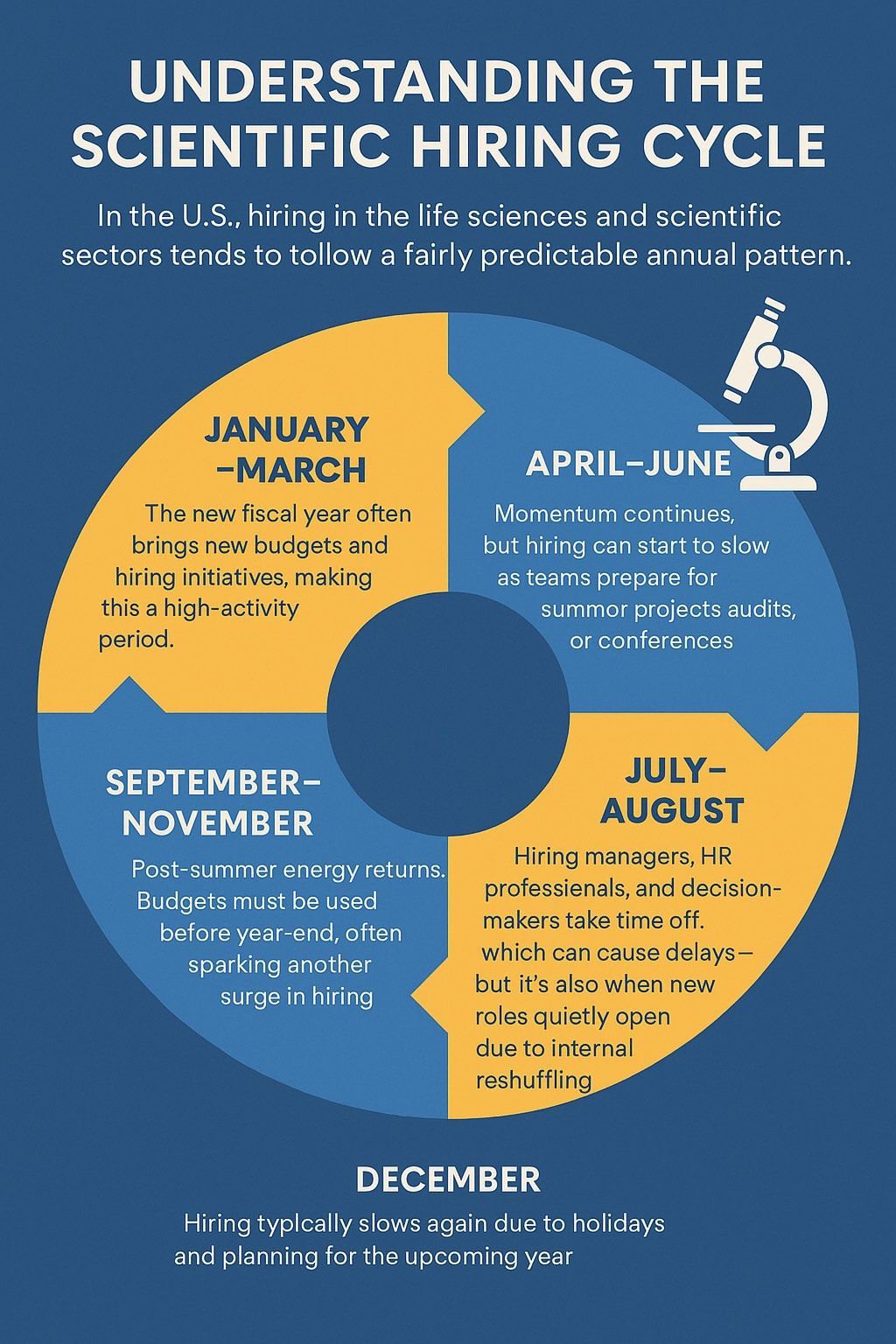
Blue infographic titled “Understanding the Scientific Hiring Cycle” with a four-part circular timeline.
By ClinLab Solutions Group July 9, 2025
Summer might feel like the slow season—vacation mode kicks in, schools are out, and the office AC becomes your best friend—but for job seekers in scientific roles, the warmer months hold strategic opportunities. While the U.S. hiring cycle does have its seasonal rhythms, summer can be a surprisingly smart time to be on the job […] The post What to Expect When Job Hunting This Summer appeared first on ClinLab Solutions Group.

Scientist in lab coat and mask holding an orange liquid flask with a test tube nearby
By ClinLab Solutions Group July 2, 2025
When life science companies need to scale their teams quickly and reliably, they can’t afford to rely on generalist staffing firms. That’s why hundreds of biotech, pharmaceutical, and diagnostics companies across the U.S. turn to ClinLab Staffing—a firm built exclusively for the scientific community. A Specialized Partner in Life Science Talent ClinLab Staffing is not […] The post Why ClinLab Staffing is a Top Choice for Life Science Staffing in the U.S. appeared first on ClinLab Solutions Group.
Gloved lab worker holding a sign: “Why specialized staffing outperforms generalists in the life sciences industry.”
By ClinLab Solutions Group June 25, 2025
At ClinLab Staffing, we’ve spent the past two decades embedded in one of the most demanding and fast-paced sectors of the global economy: the life sciences. From startup biotechs in Cambridge to Fortune 100 pharmaceutical companies nationwide, our clients all face the same challenge—finding and retaining highly specialized talent that can deliver under pressure. Increasingly, […] The post Specialized Staffing Outperforms Generalists in the Life Sciences Industry appeared first on ClinLab Solutions Group.

Scientist in a lab holding two test tubes, looking concerned, with blue and orange liquids on the table
By ClinLab Solutions Group June 20, 2025
The Hidden Costs of a Bad Science Hire—And How ClinLab Helps You Avoid Them In scientific research, pharmaceuticals, and biotech, making the right hire isn’t just important—it’s critical. The wrong hire doesn’t just affect productivity; it can jeopardize project timelines, compromise data integrity, and cost far more than just salary. At ClinLab Staffing, we specialize […] The post The Hidden Costs of a Bad Science Hire appeared first on ClinLab Solutions Group.

Medical team gathered around a laptop in a clinical setting, discussing a document with focused expressions
By ClinLab Solutions Group June 12, 2025
In clinical research, trial timelines are everything. A single staffing gap—whether it’s a missing CRA or a delayed project manager—can derail months of planning, costing sponsors money, slowing regulatory progress, and pushing critical therapies farther from the patients who need them. If you’re running or scaling a Clinical Research Organization (CRO), building a team that’s […] The post Clinical Trial Staffing: How to Build a Resilient CRO Team appeared first on ClinLab Solutions Group.

Silhouetted people in a modern lobby at sunset, with bright reflections on the polished floor.
By ClinLab Solutions Group June 4, 2025
June 2025 The hiring landscape in life sciences is evolving, and both employers and job seekers need to adapt. With a growing reliance on virtual interviews, skills-based assessments, and AI-driven screening, the hiring process is becoming more efficient—but face-to-face connections still play a vital role. Companies are balancing speed and precision when selecting candidates, while […] The post Job Interviews Are Evolving – What to Expect appeared first on ClinLab Solutions Group.
Show More